All guides › Laboratory risk and service review
Why can a laboratory meet its turnaround-time target and still leave patients waiting?
A turnaround-time target applies to the interval the laboratory chose to measure. A result can meet a receipt-to-authorisation target while the patient waits longer because of time before receipt or after authorisation.
Worked example at a glance
25 minutes
Receipt to authorisation
30 minutes
Illustrative laboratory target
120 minutes
Collection to first clinical review
Define which clock you mean
Laboratory turnaround can be measured from different starting and finishing points. Receipt to authorisation is useful for monitoring time within the laboratory. From a patient pathway perspective, the relevant interval may begin when the test is ordered or collected and extend to clinical review or action. [1]
Both clocks can be useful if the timestamps mean what you think they mean. For example, the time of authorisation tells you when a result was released. The time of first clinical review answers a different question.
Follow one result through both clocks
In a fictional service, the target is authorisation within 30 minutes of laboratory receipt. A specimen is collected at 09:00, received at 09:45 and authorised at 10:10. The result is first reviewed by the clinical team at 11:00.

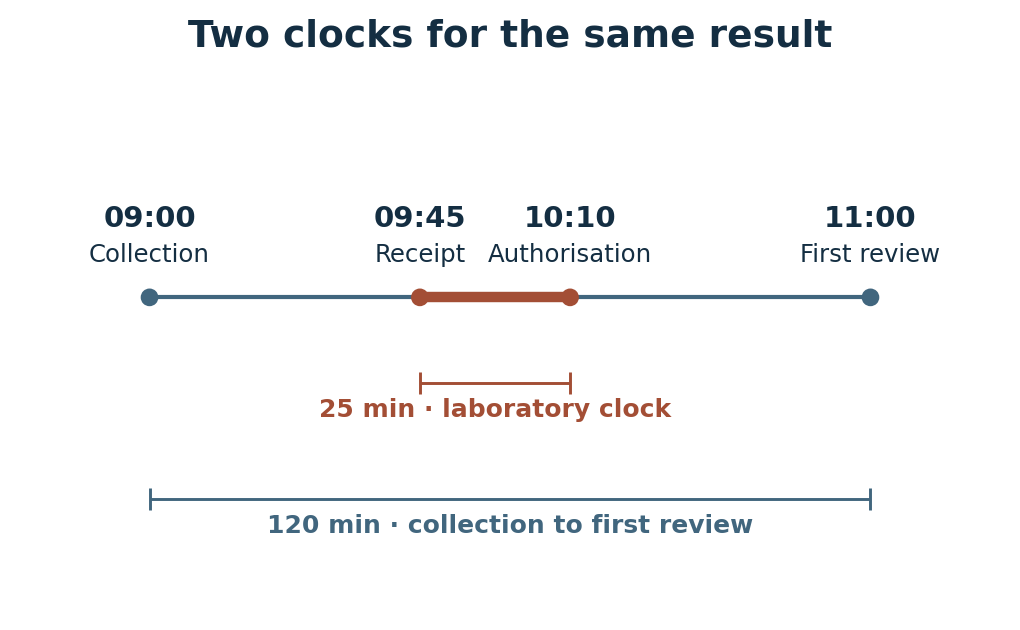
The result meets the target at 25 minutes. From collection to first review, 120 minutes pass. The two intervals are both correct. The target covers the laboratory’s 25 minutes, while the other 95 minutes sit outside it.
The first-review timestamp also leaves open when a clinical decision or action took place. Include those endpoints if they are the ones that matter to the question being asked. [1]
Use the interval that can guide improvement
Separating the stages helps the laboratory and clinical teams see where to ask questions.
| Interval | Time | In the target? |
|---|---|---|
| Collection to receipt | 45 min | No |
| Receipt to authorisation | 25 min | Yes |
| Authorisation to first review | 50 min | No |
| Collection to first review | 120 min | Wider measure |
For this result, the longest stage was authorisation to first review. That tells you where time elapsed. It does not establish why it elapsed, whether action was needed earlier or whether the delay was usual for the service.
When reviewing a service, check the pattern across relevant cases. For example, separate pathways with different urgency or transport arrangements. Report the start and end points, eligible cases and how you handled missing timestamps.
Describe the result with both endpoints
A summary can report target performance and the wider wait without confusing the two.
Example wordingReceipt to authorisation was 25 minutes and met the 30-minute laboratory target. Collection to first clinical review took 120 minutes, including 45 minutes before receipt and 50 minutes after authorisation.
Member Learning
Continue with guided laboratory learning
Explore the released courses on laboratory quality, measurement uncertainty, study preparation and statistics.
Sources and related reading
- Hawkins · Laboratory turnaround time (2007) · Discusses definitions of turnaround and the stages before and after laboratory analysis.
Read how a laboratory error could lead to patient harm · See how a histogram can reveal different turnaround patterns · Take the free risk-based approaches email course
By Stephen MacDonald · Suggest a correction · Back to Find a guide