All guides › Laboratory risk and service review
What can a near miss tell me about laboratory risk?
A near miss shows how a failure arose and where it was intercepted before harm occurred. Following both parts of the event helps you see which safeguard worked and where a similar failure could travel further next time.
Worked example at a glance
1 wrong record
A fictional manual entry
Second check
Mismatch found against the source
Before release
Draft corrected
Reconstruct what happened
A near miss gives the laboratory an opportunity to learn from an event that could have caused harm. Start with the sequence of work and the evidence available. Which task was being done? What was visible to staff? Where did the process depart from what was intended? [1] [2]
A useful account describes the conditions that made the error possible. Labelling the event simply as an entry error leaves out how the record was chosen and why the error was able to reach the next step.
Find where the error stopped
During a fictional manual reporting process, a result is entered into the wrong draft record. A second checker compares the draft with the source record, sees that the identifiers differ and has the draft corrected before release.

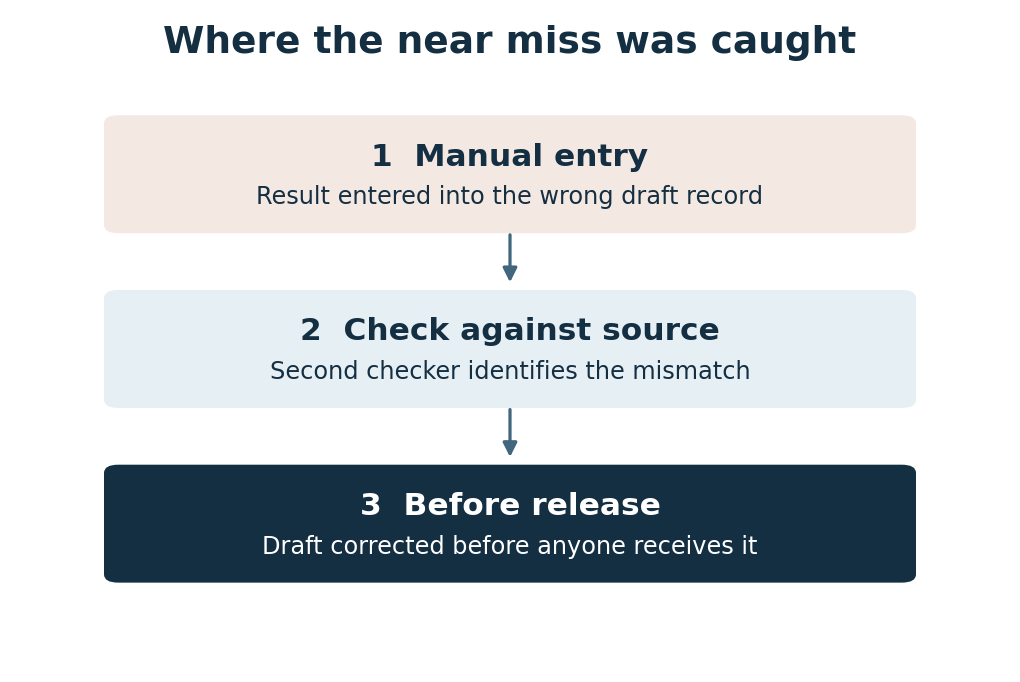
The check worked in this case. The first part of the sequence still matters because the process allowed a valid result to be linked to the wrong record. If a similar result were released, it could affect decisions for the person whose record received it or delay the correct result for the other person.
Those are possible consequences. The observed outcome here was correction before release.
Ask whether the catch can be relied on
The second checker had access to the source record and was able to compare the identifiers. The team can ask whether that comparison happens on every relevant shift and during the fallback process.
| Stage | What the team learns |
|---|---|
| Wrong draft record selected | The manual route allowed entry against a different identifier |
| Source checked before release | The comparison caught the mismatch in this case |
| Draft corrected before release | The incorrect result did not leave the laboratory |
| Same route used again | Check whether the second check is always available |
Look at what supports the check. For example, the source and draft might be hard to compare on different screens, or a second checker might be less readily available out of hours. Confirm those conditions rather than assuming them.
One reported near miss shows that the route to failure exists. The number reported also depends on whether people can detect and record such events. Use local reporting and review arrangements to learn what happens in other cases. [1] [2]
Record the failure and the catch
Give enough detail for a colleague to see where the route could be strengthened and which part already worked.
Example wordingA result was entered against the wrong draft record. The pre-release check identified the identifier mismatch against the source and the draft was corrected. Review whether the same check is available whenever manual entry is used.
Member Learning
Continue with guided laboratory learning
Explore the released courses on laboratory quality, measurement uncertainty, study preparation and statistics.
Sources and related reading
- World Health Organization · Laboratory quality management system handbook · Chapter 14 introduces occurrence management, including learning from near misses.
- NHS England · Patient safety learning response toolkit · Resources for systems-based learning, developing safety actions and planning how to monitor them.
Read how a laboratory error could lead to patient harm · Take the free risk-based approaches email course
By Stephen MacDonald · Suggest a correction · Back to Find a guide