All guides › Calibration and traceability
What makes a reference material suitable for transferring a calibration?
A reference material is suitable for transferring a calibration when its assigned value is appropriate and using it preserves the intended relationship for the samples and procedures in the chain. A certificate describes the value and its uncertainty. Evidence from relevant samples shows how well the material works in that role.
Worked example at a glance
100 units
Assigned to both candidates
±3%
Fictional performance requirement
+10%
Patient-sample differences after calibration with B
Check the material’s proposed role
A certified value describes a particular quantity in the material. Start by checking what the certificate covers, how the material should be prepared and used, and whether the uncertainty is small enough for its proposed place in the hierarchy. Material stability and consistency between units also matter when the value is transferred.
When the material is used as a secondary calibrator for patient-sample measurement, its behaviour across the relevant procedures matters. Commutability concerns whether results for that material relate across procedures as results for relevant patient samples do, within a suitable criterion. A similar matrix or the same stated value gives only part of the evidence. [1] [2]
Compare patient results after calibration
Two fictional candidate materials are both assigned 100 units. Each is used in turn as a secondary calibrator. The same three patient samples are then measured and compared with values from a reference procedure.
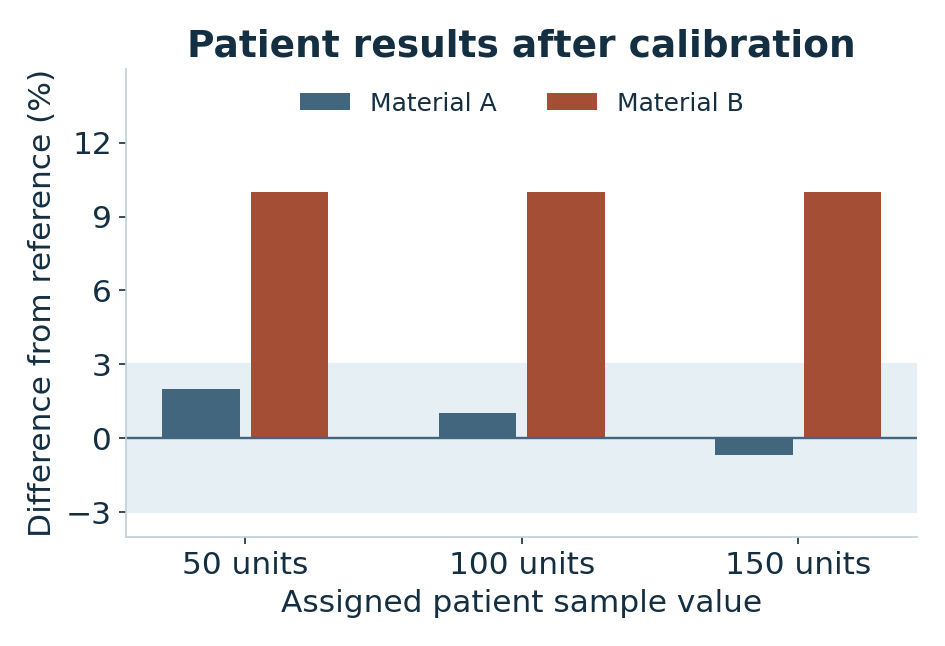
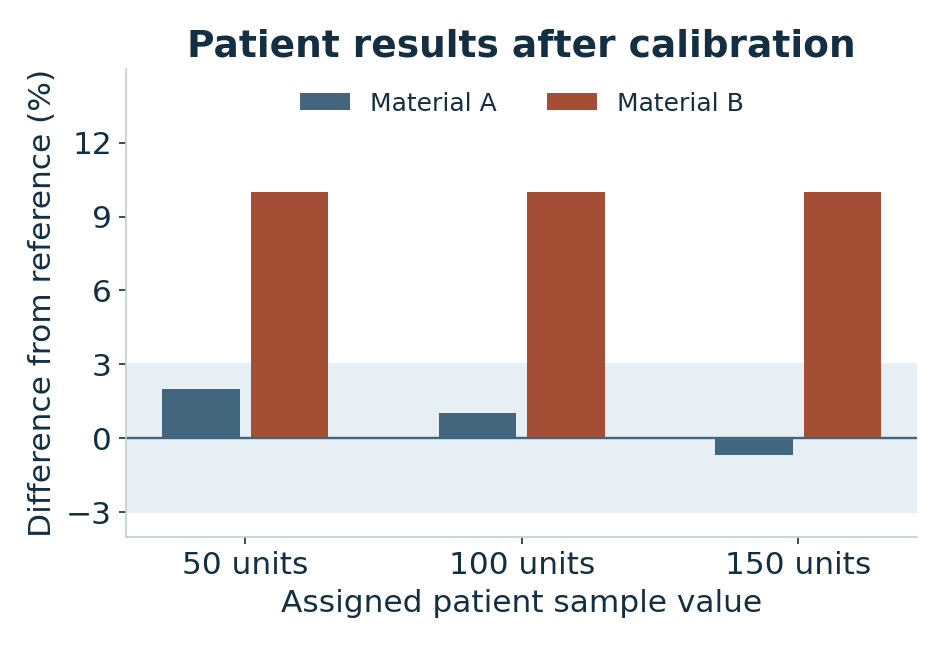
Using material A, the differences are approximately +2%, +1% and −0.7%. Using B, the differences are +10% throughout. The system can be calibrated to the assigned value on either material while still giving different results on patient specimens.
The example uses ±3% simply to make the comparison visible. The relevant performance requirement and the uncertainty of the comparison would need to be considered for the actual application. [1] [2]
Read the patient evidence alongside the certificate
The table shows the results behind the percentages. Both candidates carry the same assigned value, but they perform differently in this illustration.
| Reference result | After using A | After using B |
|---|---|---|
| 50 units | 51 units | 55 units |
| 100 units | 101 units | 110 units |
| 150 units | 149 units | 165 units |
A is the better candidate in the conditions shown. Before concluding that material B behaves differently from patient samples, check other plausible explanations, including how the calibration model fits and how the candidates were prepared. [1]
Any conclusion about suitability belongs to the procedures, sample types and concentrations for which the evidence was gathered. The three values here illustrate the reasoning.
Specify what the evidence covers
When evaluating a candidate, keep its certificate and the performance evidence together. Describe the role it was tested for and the methods involved.
Example wordingBoth candidates were assigned 100 units. Under the conditions illustrated, calibration with A gave closer agreement with reference values on the three patient samples. Further evidence would establish where that finding applies.
Member Learning
Build and explain an uncertainty estimate
Work through a simple estimate using routine control results and calibrator information, then practise explaining where it can be used.
Sources and related reading
- Camara et al. · Assessing commutability by calibration effectiveness (2018) · Shows how patient-sample results can be used to assess a candidate calibrator.
- Miller et al. · Commutability criteria for secondary calibrators (2023) · Explains how to relate a material’s contribution to bias to its intended use.
Read what a calibrator certificate tells you · Read how commutability affects EQA comparisons · Take the free traceability email course
By Stephen MacDonald · Suggest a correction · Back to Find a guide